

Single Dental Implants vs Full-Mouth Dental Implants: Which Is Right for You?Choosing between Single Dental Implants vs Full-Mouth Dental Implants depends on how many teeth you are missing, your jawbone condition, and your overall oral health. Missing teeth can affect more than just your smile. They may make chewing and eating difficult, affect your speech, and reduce your confidence during social interactions.
Dental implants can replace missing teeth with artificial teeth designed to look and function like natural teeth. However, the most suitable treatment depends on your individual dental needs. When researching dental clinics, you may come across two common options: single dental implants and full-mouth dental implants. Understanding their differences can help you make an informed decision about your smile.
What Are Single Dental Implants?
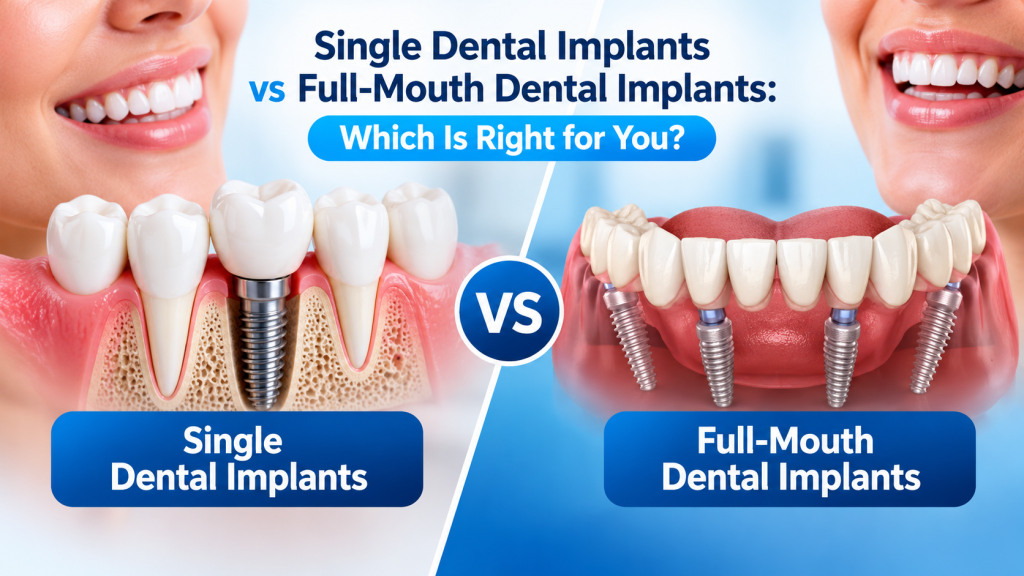
A single dental implant replaces one missing tooth using an implant-supported crown. The treatment generally involves three components: a titanium implant post placed in the jawbone, an abutment that connects the implant to the crown, and a custom-made crown designed to resemble a natural tooth.
Single dental implants may be suitable for people who have lost one tooth because of tooth decay, trauma, periodontal disease, or other dental conditions. A dentist will assess the surrounding teeth, gum health, and available jawbone before recommending treatment.
Benefits of Single Dental Implants
- Natural appearance: The replacement crown is designed to blend with your existing teeth.
- Preserves neighbouring teeth: Unlike a conventional tooth-supported bridge, a single implant does not normally require adjacent teeth to be prepared for support.
- Improved chewing: An implant-supported crown can help restore function when the implant heals successfully.
- Long-term solution: With proper oral hygiene, regular dental visits, and appropriate maintenance, dental implants can last for many years.
What Are Full-Mouth Dental Implants?
Full-mouth dental implants are used to restore an entire upper or lower arch of teeth, or both arches, when many or all teeth are missing or cannot be predictably preserved.
Depending on the patient’s condition, the dentist may recommend an implant-supported full-arch prosthesis using techniques such as All-on-4 or All-on-6. These approaches use strategically positioned implants to support a complete set of replacement teeth.
The number of implants required depends on factors such as jawbone volume, bone quality, bite forces, medical history, and the design of the final prosthesis. Some patients may need additional procedures, such as bone grafting, before or during implant treatment.
Benefits of Full-Mouth Dental Implants
- Complete tooth replacement: They can restore an entire dental arch when most or all teeth are missing.
- Improved chewing function: An appropriately designed implant-supported prosthesis can help patients eat more comfortably.
- Stable replacement teeth: The prosthesis is supported by dental implants rather than relying solely on removable denture retention.
- Restored smile confidence: Replacement teeth can improve the appearance of the smile and facial support.
- Comprehensive rehabilitation: Treatment can address multiple missing teeth as part of one coordinated treatment plan.
Single Dental Implants vs Full-Mouth Dental Implants: Key Differences
The main difference between single dental implants and full-mouth dental implants is the number of missing teeth being replaced and the design of the restoration.
| Feature | Single Dental Implants | Full-Mouth Dental Implants |
|---|---|---|
| Purpose | Replace one missing tooth | Replace most or all teeth in one or both arches |
| Implants required | Typically one implant for one tooth | Usually several implants supporting a full-arch prosthesis |
| Restoration | Individual implant-supported crown | Full-arch implant-supported bridge or prosthesis |
| Treatment complexity | Generally less extensive | Usually involves more comprehensive planning and treatment |
| Cost | Generally lower for one missing tooth | Generally higher because of the extensive restoration |
| Healing and recovery | Depends on implant placement and bone healing | Depends on the number of implants, surgical procedures, and restoration plan |
Single dental implants are generally more economical when only one tooth needs replacement. Full-mouth implant treatment usually costs more because it involves multiple implants, a larger prosthesis, and potentially additional procedures.
The overall treatment timeline also varies. A single implant may require a healing period before the permanent crown is attached. In selected full-arch cases, a temporary prosthesis may be provided soon after surgery, provided the patient’s clinical condition allows it. Immediate temporary teeth are not suitable for every patient.
When comparing Single Dental Implants vs Full-Mouth Dental Implants, it is important to consider not only the number of implants but also the expected function, maintenance requirements, treatment duration, and long-term suitability for your oral health.
How to Choose the Right Dental Clinic
Choosing an experienced dental team is an important part of implant treatment. Different treatment recommendations may be appropriate depending on your clinical examination, jawbone condition, oral health, and treatment goals.
Before selecting a dental clinic, consider the following factors:
- Check the dentist’s qualifications: Ask about relevant training and experience in implant dentistry.
- Request a detailed treatment plan: Understand the proposed procedure, alternatives, risks, and expected timeline.
- Ask about implant and crown materials: Clarify which implant system and restoration materials will be used.
- Get a complete quotation: Check whether the price includes scans, surgery, abutments, temporary teeth, final crowns or prostheses, and follow-up visits.
- Review hygiene and aftercare: Ask about infection prevention, maintenance appointments, and support if complications occur.
- Request an individual assessment: The dentist should evaluate your gums, jawbone, bite, and overall oral health before recommending implants.
Which Option Is More Cost-Effective?
The most cost-effective treatment depends primarily on how many teeth need replacement and the condition of the remaining teeth.
If you are missing only one tooth, a single dental implant may be a practical option because it replaces that tooth without requiring a full-arch restoration.
If you are missing most or all of your teeth, an implant-supported full-arch prosthesis may be more practical than placing a separate implant for every missing tooth. However, the most appropriate design depends on your bone structure, bite, oral health, and clinical needs.
When comparing treatment quotations, do not focus on price alone. Consider the quality of the proposed restoration, the dentist’s experience, the materials used, the maintenance plan, and any additional procedures that may be required. If different dentists recommend substantially different treatments, obtaining a second opinion may help you understand your options.
Conclusion
Both single dental implants and full-mouth dental implants can restore missing teeth and improve oral function. The right choice depends on how many teeth are missing, the condition of your jawbone and gums, your overall health, and your long-term dental goals.
Before proceeding, discuss the expected benefits, risks, costs, treatment timeline, and aftercare requirements with a qualified dentist. A comprehensive examination will help determine which approach is appropriate for your needs.
Ultimately, understanding Single Dental Implants vs Full-Mouth Dental Implants can help you compare your options and make a more informed decision about restoring your smile.